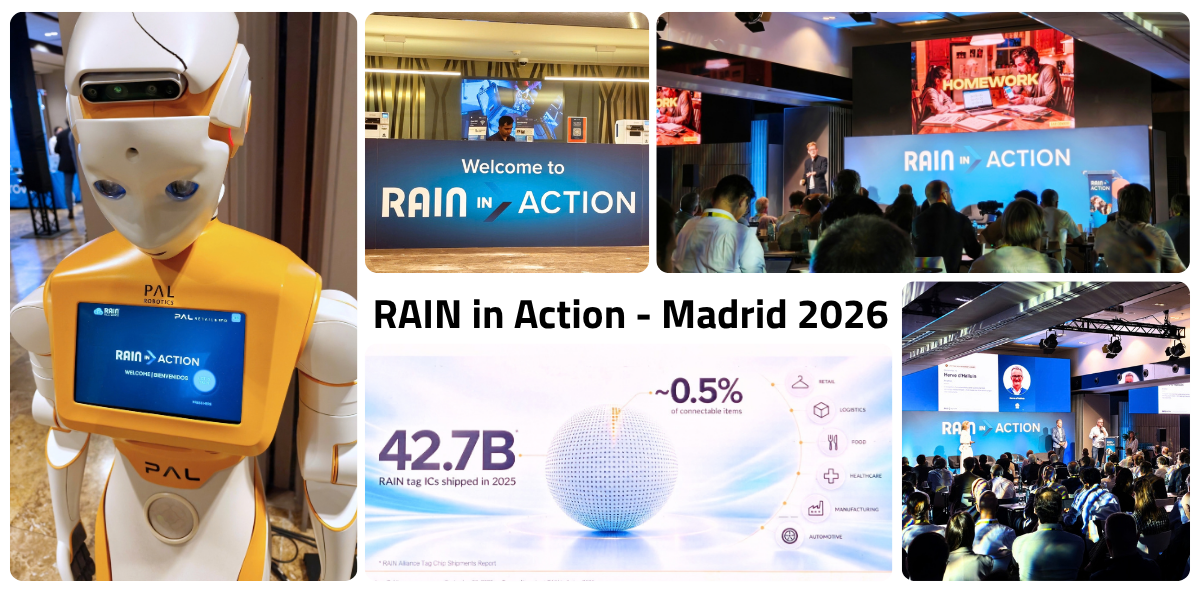
What can logistics and industry learn from marathon runners? Key takeaways from the RAIN in Action conference in Madrid

Picture the starting line of a major city marathon: several thousand or even tens of thousands of runners setting off simultaneously in a dense crowd, where human bodies form a massive, natural barrier dampening radio waves. A moment later, look at the finish line of a cycling race: a tight peloton crossing the line at 60 km/h on bikes with metal and carbon frames. In both cases, fractions of a second decide podium places, personal bests, or official results – there is no room for delays, duplicates, or missing a single athlete.
This is not an abstract laboratory test, but the daily reality for RACE RESULT, a German company and global leader in precision sports timing. And while retail, automotive, pharma, and warehouse logistics dominated this year’s RAIN in Action conference in Madrid, it was this sports presentation that made the greatest impression on me.
Why? Because sports relentlessly concentrate at a single point all the most difficult challenges faced by radio physics: crowds, water in human bodies, metal, dynamic movement, and extreme weather conditions. Since RAIN RFID technology performs flawlessly in such a demanding environment, the occasionally repeated myth that “RFID won’t work in tough industrial settings” can finally be put away on the shelf of historical trivia.
Table of Contents
RFID technology from the ground up: Facts and myths
Madrid as a market seismograph: RFID is no longer an experiment, but a foundation of processes

Organized by the RAIN Alliance at the Novotel Madrid Center, the conference gathered over 600 decision-makers from around the globe – chief operating officers, supply chain directors, system architects, representatives of leading standards organizations (including GS1 and UNECE), and technology providers.
The stature of the event was best defined by the presence of global brands that not only deploy the technology on a massive scale but also set the direction for the entire retail and logistics industry. Plenary sessions, panels, and the agenda featured implementations and case studies from giants such as Amazon, UPS, IKEA, Inditex, Decathlon, and Primark.
Walking among the booths of leading chip and inlay manufacturers (such as Tageos, Hana, NXP, and Impinj) and listening to market leaders, one thing became crystal clear:
- The pace of adoption is breaking records: No one in the room was asking “whether RAIN RFID works” anymore. Today, the global market consumes well over 45 billion tags annually, recording steady, dynamic growth.
- A shift in focus: Today’s discussions do not revolve around the mere act of reading a tag, but around managing terabyte streams of data, filtering them at the edge (edge computing), and exchanging information instantaneously with enterprise ERP/WMS systems.
New standards and strict regulations: The era of the Digital Product Passport is coming
In both presentations and hallway conversations, one of the most frequently mentioned concepts was the Digital Product Passport (DPP) and its associated European regulations (Ecodesign for Sustainable Products Regulation – ESPR).
EU requirements regarding supply chain transparency, carbon footprint tracking, and the circular economy are no longer distant concepts – they will soon directly impact industries such as apparel, batteries, chemicals, and machinery manufacturing:
- GS1 identification standards are becoming the universal, global language of data exchange.
- Businesses face a strategic choice: implement a passive 2D code solely to fulfill the letter of EU law, or adopt modern RFID media that satisfies DPP requirements while giving the company leverage for full warehouse automation and error-free shipment verification at loading docks at no extra cost.
- In parallel, ESG requirements emphasize solutions with a reduced environmental footprint – evidenced in Madrid by inlays completely free of plastic substrates (PET-free), made entirely of pure paper.
We are not talking about tags – we are talking about a complete solution
Today, no mature business discusses the tag in isolation from the rest of the ecosystem. A tag is merely one building block in the entire architecture – essential, but on its own, it solves no business problem.
Modern market challenges require viewing automatic identification as a cohesive organism where every element must work in harmony:
- Next-generation hardware and sensing: The miniaturization of circuits allows direct UHF reading from standard mobile devices, while passive, battery-free sensors can record temperature or material deflection, harvesting operating power directly from the signal emitted by the reader.
- Tech fusion and AI: RFID readers increasingly work in tight tandem with industrial cameras and computer vision / AI algorithms. For example, cameras verify the movement trajectory of a forklift, while a radio gate confirms the pallet contents, eliminating ghost reads (false reads of items passing near the read point).
- System integration: Middleware must operate transparently – filtering millions of raw events and injecting only relevant data into the WMS, enabling precise, real-time business decisions.
Know-how: The difference between implementation failure and success
Returning to the sports analogy: it is not just the chip in the race number or on the bike fork that records the result. Success depends on the precise tuning of antennas in the timing mat, appropriate transmission power, algorithms filtering ground signal reflections, and the durability of the hardware under harsh weather conditions.
It is exactly the same in modern industry and logistics. A project’s success is not guaranteed merely by selecting a proven inlay, but rather by:
- Correctly matching the tag’s material construction to the specific environment (steel, liquids, dust, washdown processes, or freezers).
- Aligning radio gates with the physical rhythm of warehouse operations and forklift movement.
- Software architecture that seamlessly connects hardware with the ERP system.
- Above all: the practical expertise of an engineering team that can anticipate radio wave behavior in complex factory environments.
At Etisoft, we have been saying for years that we deliver process peace of mind, not just individual components. Our experiences in Madrid reinforce our belief that our approach – combining in-house label converting facilities, partnerships with global technology leaders, and deep software and integration expertise – is the only safe path forward for a modern enterprise.
Get in touch with us! We’ll help you find the right solution