RFID labels in fixed asset inventory – a fast and durable way to mark assets

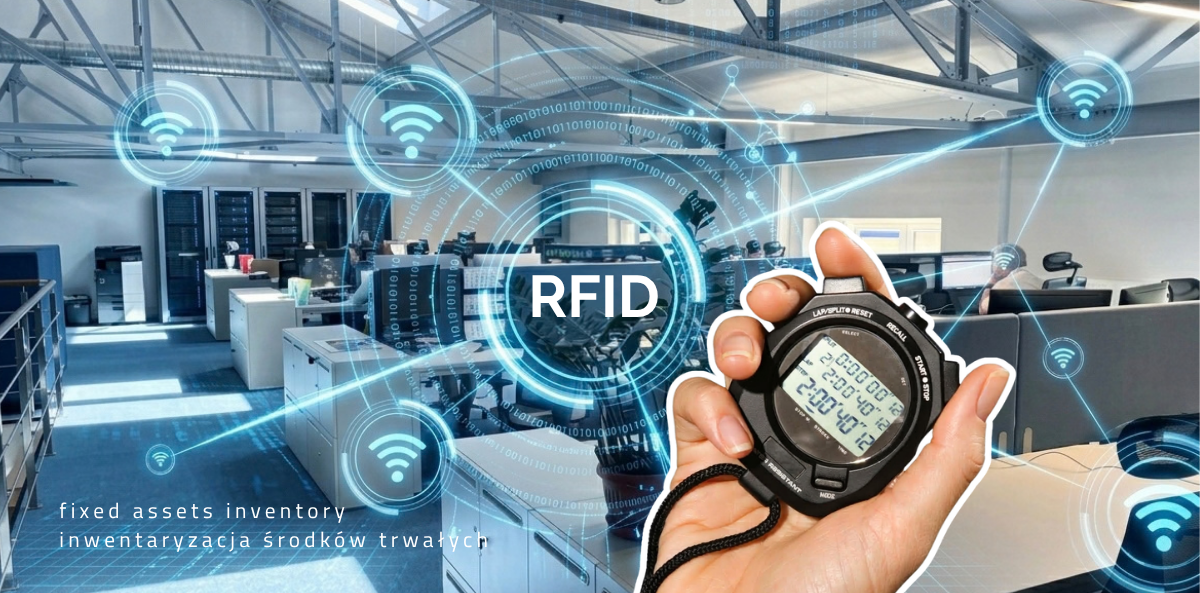
In our test, taking inventory of 170 tagged items took 2 minutes 40 seconds with UHF RFID and 35 minutes with barcodes. In this test, RFID reduced inventory time by 92.4%. A UHF RFID reader can read multiple tags within its range without the need to directly “aim” at each one. However, for an RFID tag to function throughout the entire lifecycle of a fixed asset, well-selected RFID labels are essential. Check out how the test went, what determines label durability, and what else you need for RFID asset tracking.
Fixed asset inventory doesn’t have to mean spending hours writing down numbers, walking from room to room with a clipboard, and manually entering data into the system later. Companies are increasingly adopting RFID technology to significantly speed up asset identification. The key component of this solution is the RFID label. It identifies a specific asset and links it to the information stored in the system, which is why choosing the right label is crucial for the entire inventory process.
We write more about the RFID inventory process in warehouses and for fixed assets in our article: RFID inventory: how to shorten warehouse audits and fixed asset tracking.
Table of Contents
How does RFID inventory differ from physical audits and barcodes?
A traditional physical audit requires manually reading and recording the number of every single asset. Barcodes streamline this process, but you still have to approach each tagged item and point the reader directly at the code.
UHF RFID works differently. A UHF RFID reader can read multiple tags located within its range without the need to directly “aim” at each one.
How long does an RFID inventory take compared to barcodes? Our test on 170 items
To check how big this difference is in practice, we conducted our own test in a company open-space office. The area contained:
- 48 workstations, each consisting of a desk, a chair, and a cabinet,
- 3 printers,
- 14 shared cabinets,
- 1 conference table and 6 chairs,
- 1 sofa,
- 1 small table.
We tagged every item, making it a total of 170 items. Inside the cabinets, labels were placed on the inner side of the doors. We then conducted an inventory of the exact same area using barcodes and RFID.
Test result: inventory of 170 tagged items with barcodes vs. UHF RFID
| Parameter | Barcodes | UHF RFID |
|---|---|---|
| Number of tagged items | 170 | 170 |
| Inventory time | 35 min | 2 min 40 s |
| Time per item | approx. 12.35 s | approx. 0.94 s |
| Time saved | – | 32 min 20 s |
| Time reduction | – | 92.4% |
| RFID vs. barcodes time ratio | – | 13.1× faster |
The results were unequivocal. In our test, the RFID inventory took just 2 minutes and 40 seconds, whereas the same inventory using barcodes took 35 minutes. This means that RFID reduced the time needed to complete the audit by 92.4%, or by more than half an hour.
This is the result of a specific test conducted under defined conditions. Actual efficiency is influenced by factors such as the number and arrangement of assets, label design, and operating environment. However, the test clearly demonstrates the fundamental difference stemming from the reading method itself.
Why is UHF RFID used for fixed asset inventory?
In fixed asset tracking, the ability to read tags from greater distances and detect multiple tags simultaneously is particularly important. That is why UHF RFID is used.
An employee can walk through a room, and the reader registers all tagged assets within its range. There is no need to point the device at each label one by one. It is precisely this ability to read multiple tags at once that makes UHF RFID ideal for auditing large quantities of items.
The RFID label as an asset data carrier – what can be placed on it?
An RFID label is not just a sticker with a number. It contains a chip and an antenna, enabling it to be read wirelessly. Additionally, human-readable information can be printed on the surface of the RFID label, such as:
- Asset number,
- Barcode or 2D code,
- Organization name,
- Additional markings or logos.
Thanks to this, a single tag can combine electronic identification with visual asset marking.
In asset tracking, RFID labels can be used to tag a wide variety of assets: computers and office equipment, as well as desks, chairs, cabinets, shelving units, conference room equipment, machinery, or other fixed assets. Read more about RFID systems, including inventory tracking, here.
Why does inventory label durability matter?
An inventory label should remain on the asset throughout its entire service life. In practice, it may be exposed to abrasion, moisture, water, and regular cleaning. Therefore, “standard” labels are unsuitable for marking fixed assets. A better solution is durable film labels made of materials resistant to operating conditions.
Adhesive is equally important. It should be selected so that it can be applied to many types of surfaces where the label will be placed—such as plastic, varnished wood, metal, or other materials. However, there is no universal adhesive that performs identically on every surface.
A well-chosen label should simply stay in place and remain readable for years.
How to tag metal items with RFID?
One of the main challenges is tagging items made of metal or containing metal components. In such cases, on-metal RFID labels specifically designed to operate on metal surfaces are used.
Before full implementation, it is worth testing labels on actual objects. The exact same tag type may behave differently on plastic, wood, varnished surfaces, and metal. We write about solutions for these applications in our post: RFID on metal surfaces.
How to get durable printing on an RFID inventory label?
RFID allows information to be read electronically, but the asset number should also be visible to the user. That is why print durability is more important than it might seem.
A reliable solution is thermal transfer printing using resin ribbon. It produces print resistant to abrasion and heavy usage, ensuring that the asset number or barcode remains legible for a long time.
What else is needed for RFID asset tracking?

The label itself is the foundation, but an RFID inventory system also includes:
- Mobile RFID reader – used during the audit,
- RFID printer – used to print and encode labels,
- Software – responsible for collecting reads, comparing them with asset registers, and generating inventory reports.
All these elements should be selected as a single, cohesive system. Nevertheless, the label remains the element directly attached to a specific asset throughout its entire lifecycle.
RFID labels for asset tracking at Etisoft
We offer complete solutions for asset tagging and identification: durable RFID labels, asset tags, RFID printers and readers, as well as software supporting the inventory process. For us, the key is matching the label to the specific item type and its operating environment. For demanding applications, we also provide specialized solutions designed for metal surfaces.
FAQ
Will an RFID reader read a label inside a closed cabinet?
In our test, labels inside cabinets were affixed to the inner side of the doors. Taking inventory of the entire open space, including these cabinets, took 2 minutes and 40 seconds. The same label type may behave differently on various materials, so it is recommended to test readability on actual furniture prior to implementation.
How does RFID inventory show missing fixed assets?
The reader registers tags within its range, and the software compares the collected reads against the asset register to generate the audit report. Items in the register that were not detected are flagged for manual verification.
Does an RFID label replace a barcode?
Not necessarily. Human-readable text, barcodes, or 2D codes can be printed directly on the surface of an RFID label, combining wireless reading with visual identification in a single tag. Thermal transfer printing with resin ribbon ensures long-lasting legibility.
Will a single adhesive work on every surface?
No. Adhesive must be chosen according to the specific surfaces where the label will be applied, such as plastic, varnished wood, or metal. There is no single adhesive that behaves identically on all surfaces, which is why labels should be tested on actual items before deployment.
Will an RFID label withstand regular cleaning?
A fixed asset label should resist cleaning agents, moisture, abrasion, and temperature fluctuations. Synthetic materials such as PET are most commonly used, and the adhesive is selected to withstand environmental factors and routine cleaning. Thermal transfer printing with resin ribbon provides strong chemical and wear resistance.
How do you prepare RFID labels before applying them?
Labels are printed and encoded using an RFID printer. The printed surface contains human-readable data, while the encoded electronic chip links the label to the specific asset record in the system.
What influences UHF RFID label readability?
UHF RFID labels operate in the 860–960 MHz frequency band and can be read from long distances. Actual read performance depends on factors such as asset density, spatial layout, tag construction, and the surrounding physical environment.
What data can be stored in an RFID chip?
The tag’s memory can store a unique EPC identifier, an asset number, user data, ERP-linked identifiers, and information regarding location or department assignment.
What happens if an RFID label is damaged or peels off?
The asset loses its capability for quick electronic identification and must be re-tagged. The most common issues with labels, such as peeling or illegible printing, stem from selecting a label unsuitable for the given operating conditions.
Summary
UHF RFID transforms the way fixed asset inventories are conducted. Instead of manual recording or scanning barcodes one by one, multiple tags can be read automatically in a single pass.
Our test illustrates the scale of this difference: 170 tagged items were inventoried in 2 minutes and 40 seconds, compared to 35 minutes using barcodes—a 92.4% reduction in time.
However, the key to successful implementation is a properly selected RFID label. It must be tailored primarily to the item itself, its surface material, and operating conditions. Durable materials, the right adhesive, an appropriate RFID inlay, and wear-resistant printing determine whether the tag remains operational throughout the asset’s entire service life.
RFID doesn’t start with the reader — it starts with the right label.
