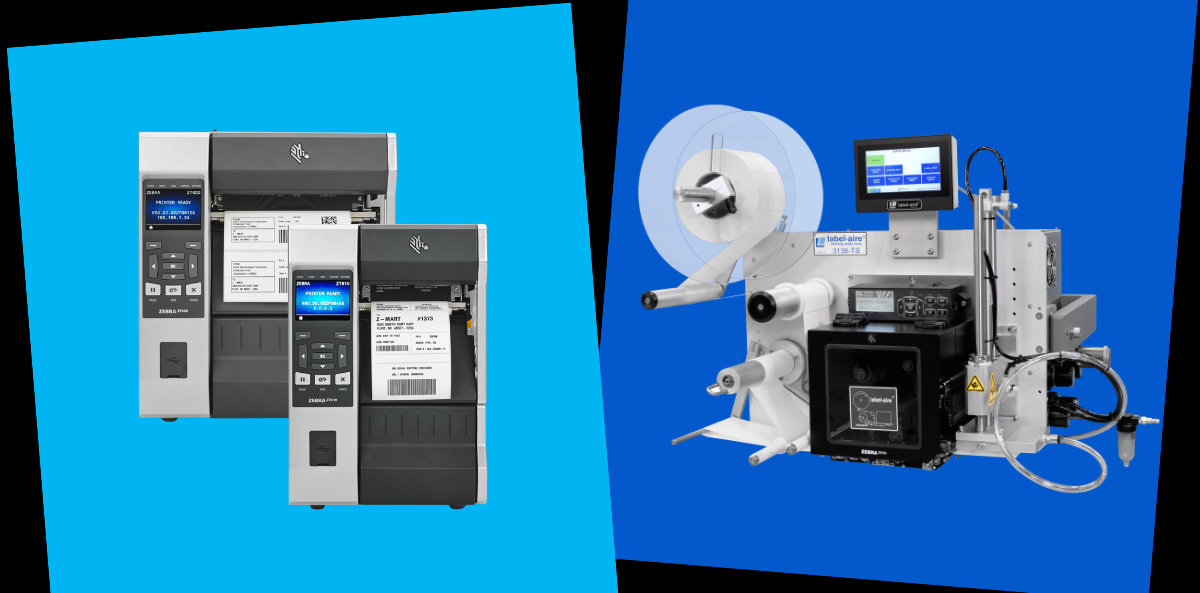
Label printers vs Print and Apply Systems – what to choose in modern manufacturing?

With the advancement of automation and growing requirements for product traceability, more and more companies face a key question: is a standard self-adhesive label printer enough, or is it worth implementing an automatic Print and Apply system? In the market, this solution functions as professional industrial labeling machines.
The answer is not obvious, because choosing the right solution depends on many factors – such as the volume of production, the degree of line automation, logistical requirements, or the need to work with variable data.
Table of Contents
Label printer for self-adhesive labels – flexibility and low entry barrier
Label printers have been a basic tool in product marking processes for years. They are relatively inexpensive, easy to use, and extremely versatile. In many companies, the process of implementing identification systems begins exactly with them.
The greatest advantage of printers is their flexibility. The user can change the content of the label at any time, adapt it to a specific product, batch, or order. In practice, this means the ability to quickly respond to the changing needs of production or logistics.
Etisoft’s offer includes both compact desktop printers and advanced industrial models that perform well in demanding manufacturing environments.

Limitations of traditional labeling
One of the disadvantages is that as the scale of operations grows, limitations appear. Manual label application begins to slow down the process, the number of errors increases, and the quality of application becomes uneven. Operators may not keep up with the pace of the production line, which leads to downtime or the need to hire additional employees.
At this exact point, many companies begin to consider automatic label application.
Print and Apply Systems – full marking automation
The most advanced solution is Print & Apply systems. These are modern automatic industrial labeling machines that combine the functions of a printer and an applicator in a single device. The label is printed and immediately applied to the product.
This solution eliminates the need to store different versions of labels and allows working with data generated in real-time – for example, directly from an ERP or MES system.
Where does a Print and Apply systems perform best?
Systems such as Etisoft PA431, IMA FlexiMate series, or Arca Linerplus are widely used in logistics, e-commerce, and large manufacturing plants. In distribution centers, this efficient industrial labeling machine is responsible for labeling cartons and pallets in accordance with GS1 standards. In the pharmaceutical industry, it supports the process of product serialization and traceability.
How to automatically mark cartons of variable height? Read about the solution!
Their greatest advantage is full automation and the elimination of human error. Each label is printed based on current data, which significantly reduces the risk of mistakes.
Of course, such an automatic labeling machine involves a higher investment cost and the need for integration with IT systems, but in the case of high volumes, the return on investment happens very quickly.
Automation of marking flat and thin products. Discover the ARCA system!
What does the choice look like in practice?
In theory, comparing technologies is simple, but in practice, the decision should always result from a process analysis.
In a small manufacturing company, where production takes place in short runs, a standard label printer will be fully sufficient. It gives flexibility and does not generate high purchase costs.
On the other hand, in a large logistics center or a manufacturing plant with a high level of automation, the choice almost always falls on a Print and Apply system. Only such a professional industrial labeling machine is able to ensure appropriate efficiency and integration with production management systems.
Why is choosing the right solution so important?
One of the most common mistakes is choosing a device “over the top” or – conversely – a too simple solution that quickly stops meeting the requirements.
Therefore, a process approach is key. A few questions need to be answered:
- what is the line efficiency?
- does the data on the label change?
- should the process be fully automatic?
- what are the traceability requirements?
Only on this basis can the right technology be selected.
Technology comparison
| Feature | Label printer | Industrial labeling machine (Print & Apply) |
| Investment cost | low | higher |
| Efficiency | low | very high |
| Automation | none | full |
| Human errors | high | minimal |
| Variable data | yes | yes |
| Line integration | limited | very good |
Etisoft’s role in selecting a marking system
We do not only deliver devices, but above all, we support customers in selecting and implementing the right solutions. Thanks to our experience in many industries, we can tailor the system to a specific process – regardless of its scale.
Our offer includes, among others:
- label printers
- label applicators (labeling machines)
- Print & Apply systems
- software and IT systems integration
This approach ensures that the customer receives not just a single device, but a complete marking system that genuinely improves production or logistics.
Summary – what to choose in the end?
Choosing between a label printer and a Print & Apply system is not a matter of “better or worse”. It is a decision about how much we want to automate the marking process.
A printer will work well where flexibility and low cost matter. On the other hand, a Print & Apply system is an ideal industrial labeling machine for companies that want to achieve maximum efficiency and full control over the process.
The most important thing, however, is one – technology should be matched to the process, not the other way around.
Whether you need a compact desktop printer or an advanced industrial labeling machine is your next step – we are here to help. Write to us – we will select the perfect marking system for your company!
FAQ
What is the difference between a standard label printer and a Print & Apply system?
The main difference is the degree of process automation. A classic label printer only prints markings that a worker must manually apply to the product. On the other hand, an automatic Print & Apply industrial labeling machine prints the label and immediately, without human intervention, precisely applies it to a product, carton, or pallet moving on the production line.
When does an industrial labeling machine become a profitable investment?
The purchase of an automatic Print & Apply system pays off fastest in plants with high production volumes and in logistics centers. If manual work starts to generate delays, operators cannot keep up with the pace of the line, and errors in marking appear on products, an automatic industrial labeling machine becomes an essential element in eliminating so-called bottlenecks.
Can an automatic labeling machine print variable data in real-time?
Yes, this is one of the greatest advantages of Print & Apply systems. Unlike traditional methods, a modern industrial labeling machine can be fully integrated with company management systems (such as ERP, MES, or WMS). As a result, the device generates and prints unique data – e.g., batch numbers, weight, expiration dates, or serial codes – just before applying it to the product.
Are Print & Apply systems difficult to integrate with an existing production line?
Implementation requires a process approach and technical analysis, which is why it is worth executing with an experienced partner like Etisoft. An industrial labeling machine must be physically adapted to the production space and integrated with the company’s IT system. After professional implementation and software configuration, the system operates maintenance-free and stably.
Which industries are industrial automatic labeling machines dedicated to?
Print & Apply solutions are a standard in the logistics and e-commerce industry (marking courier packages and pallets in accordance with GS1 standards). Furthermore, an industrial labeling machine finds mass application in the food, chemical, automotive, and pharmaceutical industries, where flawless serialization and full product traceability are crucial.