How to choose an RFID encoding standard? GS1, ISO, or RAIN CIN
Implementing RFID technology is less and less a question of “whether” and more and more a question of “how.” One of the key — and unfortunately often underestimated — elements of an RFID project is the choice of tag encoding standard. This decision affects not only system interoperability, but also future scalability, compatibility with business partners, and maintenance costs. RAIN Alliance, which promotes UHF RFID technology, has for years emphasized the importance of global identification standards that enable system interoperability. RAIN RFID works with organizations such as GS1 and ISO to ensure that data encoded in one system can be read and interpreted in another — without additional translation or conversion. In this article, you will learn how to choose the right RFID encoding standard for your company’s needs and what to pay attention to in order to avoid compatibility, scalability, and system performance issues.
Table of Contents
Why is the RFID encoding standard so important? The trap of “proprietary encoding”
Many customers are tempted to create their own custom encoding scheme (so-called Proprietary Encoding). It may seem simple: “we’ll just store the employee number and date directly on the tag.” This is a mistake that RAIN Alliance calls a straightforward path to “future failure.”
Main risks:
- Lack of uniqueness: Without a global standard, you risk having two identical numbers appear in your system (for example, from different suppliers or even between different departments within your company), which can lead to paralysis of the entire system.
- Filtering problems: Standards allow readers to instantly filter out “foreign” tags. With proprietary encoding, the reader wastes time analyzing data it does not need, which drastically reduces performance.
- Lack of scalability: Encoding designed for a current process only. If your system ever needs to go beyond the walls of a single factory (for example, to a customer or service center), no one else will be able to read your data.
- “Polluting” the RFID environment with different formats
- Improper tag memory management (EPC, User Memory) – loss of consistency between tags with different chips (ICs).
What are the most important RFID encoding standards? Meet GS1, ISO, and RAIN CIN
RAIN RFID distinguishes between two main “worlds” of encoding — GS1 and ISO — and the key technical element that differentiates them is the T-bit (Toggle Bit) in the EPC memory bank:
- T-bit = 0 → GS1 encoding
- T-bit = 1 → ISO encoding
Incorrectly setting the standard may cause the tag to become unreadable or incorrectly interpreted by other systems — even if the RFID hardware itself works properly.
GS1 EPC – the standard for open supply chains
GS1 EPC (Electronic Product Code) is the most widely used RFID encoding standard, defined in the GS1 EPC Tag Data Standard (TDS). It is a natural extension of the GS1 barcode world. If your company operates in a global supply chain, works with retail networks, or partners with manufacturers using GS1 codes, this is the natural choice.
Where does it work best?
- retail
- logistics and distribution
- FMCG, food, pharmaceuticals
- open-loop projects (multiple entities in the supply chain)
Advantages:
- global interoperability
- compatibility with barcodes
- broad support from hardware and software vendors
- often required by retail chains (Walmart, Decathlon, IKEA) and partners
ISO UII – a solution for specialized industries
ISO/IEC 18000-63 allows encoding of a Unique Item Identifier (UII) using:
- AFI (Application Family Identifier) – identifiers for applications in various industries
- DI (Data Identifier) – data identifiers
- DSFID (Data Storage Format Identifier) – identifiers for data storage format
This model allows a great deal of flexibility in data structure.
Typical applications:
- aviation (IATA)
- automotive (VDA, AIAG)
- military and defense
- heavy industry
- closed-loop systems
Advantages:
- high data flexibility
- ability to store non-standard identifiers
RAIN CIN – a simpler alternative for closed systems
RAIN CIN is an ISO-based standard designed by RAIN Alliance as a response to the excessive complexity of classic ISO. It is a unique company identification number (prefix) issued by RAIN Alliance.
When is it worth using?
- in closed RFID systems (manufacturing, internal warehouse)
- when you need:
- global uniqueness
- independence from GS1
- simpler numbering management
RAIN CIN allows the use of a company prefix, after which the organization assigns serial numbers itself.
CIN encoding – T-bit = 1 + AFI = AE (hex).
Advantage: CIN allows you to create your own data structures while maintaining the global uniqueness of the code “owner.”
What do you gain by choosing an RFID standard?
By choosing GS1, ISO, or RAIN CIN, you gain:
- Filtering efficiency: Readers can be programmed to respond only to your header or your CIN number, ignoring thousands of other tags within range.
- Participation in the “global ecosystem”: Your goods can be tracked across the entire supply chain, which is crucial for trends such as the Digital Product Passport.
Which RFID encoding standard should you choose?
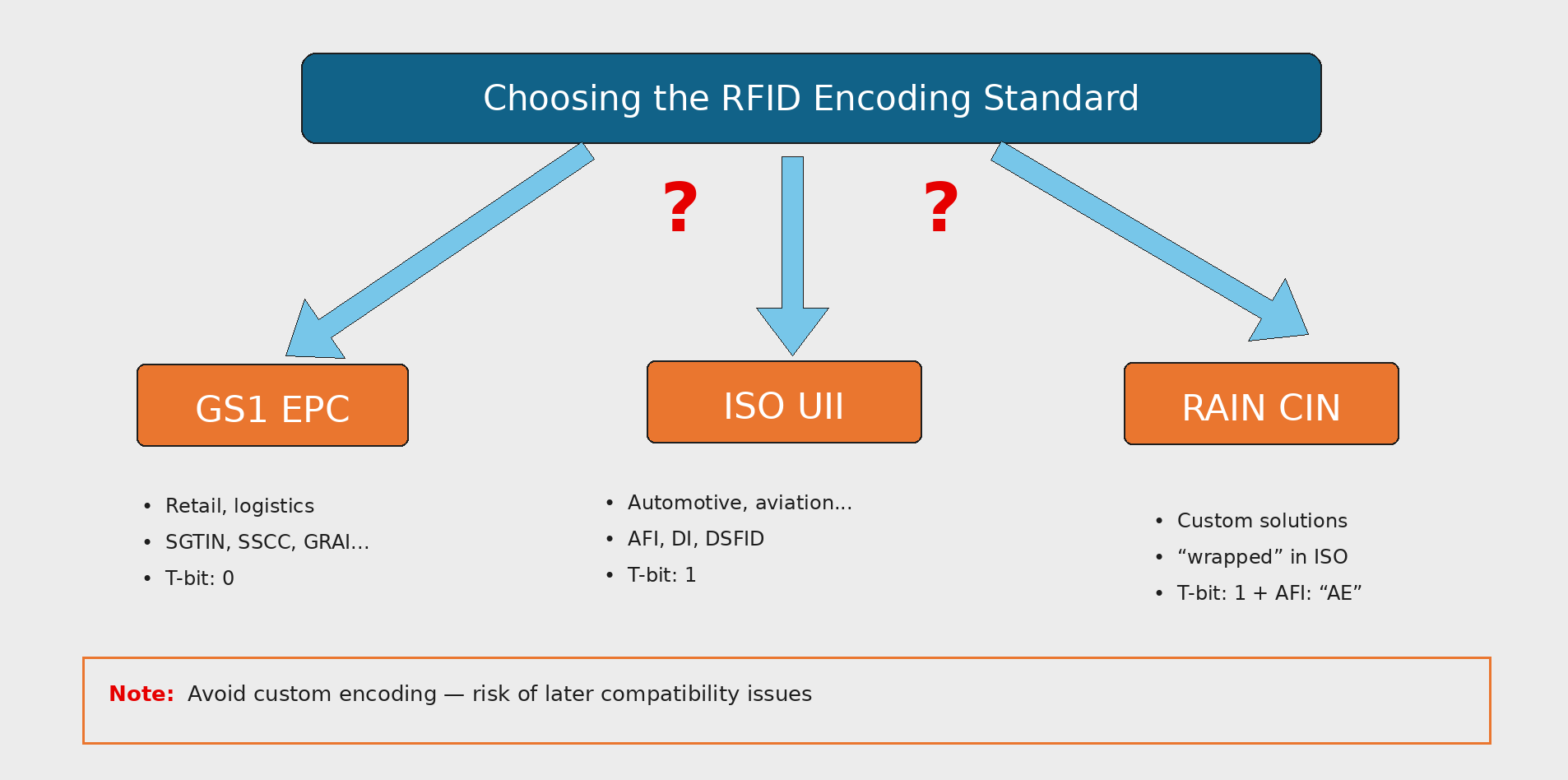
RFID encoding standard
Choosing a standard is not just a formality — it is a way to protect your investment for years to come. If you do not know where to start, use the decision scheme below:
- Will your goods go to external sales networks? Check partner requirements — Choose GS1/EPC.
- Do you operate in a closed industrial loop (e.g. automotive)? → Check ISO standards.
- Is the system temporary and/or 100% internal? → You can use your own scheme, but “wrap” it in the CIN standard — this will help you avoid problems in the future.
Summary
In RFID, hardware is only half the success. The other half is data — or more precisely, the way it is encoded. The RFID standard chosen at the beginning of the project determines its future: scalability, costs, and business compatibility.
If you are not sure which standard will be best for your case, it is better to ask at the start than to fix the system after implementation.
There is no single “best” standard — there are only the best matches for specific needs. It is worth remembering, however, that the choice made at the project stage will affect how the RFID system operates for years.
RFID hardware can be replaced; the encoding architecture is much harder to change. That is why it is worth designing it properly… before the first tag is encoded.
Contact us if you want to choose the best RFID encoding standard for your process. We will advise you on the right method, design the solution, and implement it in your company.
FAQ
What is an RFID encoding standard and why is it important?
An RFID encoding standard defines how data is stored on RFID tags, ensuring compatibility between different devices and systems. This makes it possible to effectively identify and track items in various industries, such as logistics and retail.
How do you choose the right RFID encoding standard?
The choice of standard depends on the application, reading range, and requirements regarding security and compatibility. Popular standards include EPC, ISO UII, and CIN, which are widely supported in various industrial applications.
What is the difference between GS1 EPC, ISO UII, and CIN RFID standards?
GS1 EPC focuses on product identification in the supply chain, ISO UII enables unique identification of objects on a global level, and CIN is used mainly in manufacturing and logistics for marking containers and pallets.
What are the benefits of using standards-based RFID encoding?
Standard RFID encoding ensures interoperability, greater reading reliability, and better IT system integration. It also makes asset management easier and improves operational efficiency.
Standard RFID encoding ensures interoperability, greater reading reliability, and better IT system integration. It also makes asset management easier and improves operational efficiency.
Yes, some standards may have limitations regarding read range, data transfer speed, or compatibility with existing equipment. It is worth selecting a standard that matches the specifics of your environment and business needs.