GS1 logistics label – how to print it yourself
A GS1 logistics label can be designed and printed independently, provided that the company has been assigned a GS1 Company Prefix, is able to generate an SSCC number, correctly encode the required data, and uses software compliant with the GS1 standard. In practice, this requires combining knowledge of GS1 identifiers, recipient-required data, and the right software for label design and printing. In this article, we explain what a GS1 logistics label must contain, how to prepare an SSCC code, and how to use ETILABEL software to design and print labels independently.
Table of Contents
How to generate and print a GS1 label?
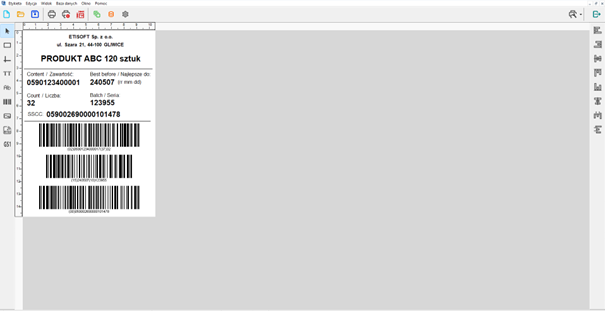
First, determine the number of variants that will constitute logistics units. Then, pay attention to the possibility of generating the appropriate number of SSCC numbers, since each of them is a mandatory element of the GS1 logistics label.
In order to assign products to the system, it will be necessary to assign them GTIN numbers, which are represented in the form of EAN-13 barcodes. To do this, you need a company identification number, which can be obtained by registering on the website of the GS1 organization.
Then, together with the recipient, you need to determine all the necessary data to be encoded. This includes lot numbers, weight or other relevant information. Designate shipping units. Such an operation may require the use of specialized label management software. Finally, you can send the prepared products with the generated GS1 logistics label to the recipient.
Creating and printing a GS1 logistics label is an essential part of effective supply chain management. By using such standards, companies can ensure better transparency, automate processes and minimize errors. Each label must be properly generated and include elements such as the SSCC or GTIN number. It must also comply with international standards.
How to design GS1 labels yourself?
Choosing the right software with GS1 compliance certification ensures that printed labels will be correctly read by the recipients’ warehouse management systems (WMS). ETILABEL software meets these requirements, specifically in two versions: Business and Integration. You can read more about the specific ETILABEL versions here.
| Criterion | ETILABEL Business | ETILABEL Integration |
|---|---|---|
| Who is it for? | For companies that want to design labels independently and maintain full control over their appearance. | For companies that focus on automating the label printing process. |
| Main application | Designing labels with GS1-128 and GS1 DataMatrix codes, as well as SSCC and GTIN numbers. | Integration with ERP systems and automatic retrieval of shipment data from databases. |
| Layout control | The user has full control over the label layout and can add the company logo and additional descriptions. | The layout can be part of an automated labelling process. |
| Error reduction | Helps prepare labels correctly in accordance with the GS1 standard. | Eliminates errors resulting from manual data entry. |
| Key advantage | Flexible design of logistics labels. | Faster shipment preparation and process automation. |
Ready-made GS1 label templates for retail chains
The ETILABEL program, in its Business and Integration versions, offers a unique functionality — a library of ready-made logistics label templates prepared according to the specific requirements of the largest retail chains in Poland. This means that suppliers do not have to spend time analysing the technical specifications of chains such as:
Auchan, Carrefour, IKEA, Intermarché, LIDL, Makro, Netto and Rossmann.
Simply select a template in A5 or A6 format, complete the data and print a label that complies with the guidelines of the given recipient.
What format does a logistics label have?
What must a logistics label contain?
A logistics label consists of several components:
- textual information at the top — primarily the company name, logo and address,
- in the central part, there is textual information and a human-readable version of the barcodes,
- at the bottom of the label, there are GS1-128 barcode symbols together with GS1 Application Identifiers (AI).
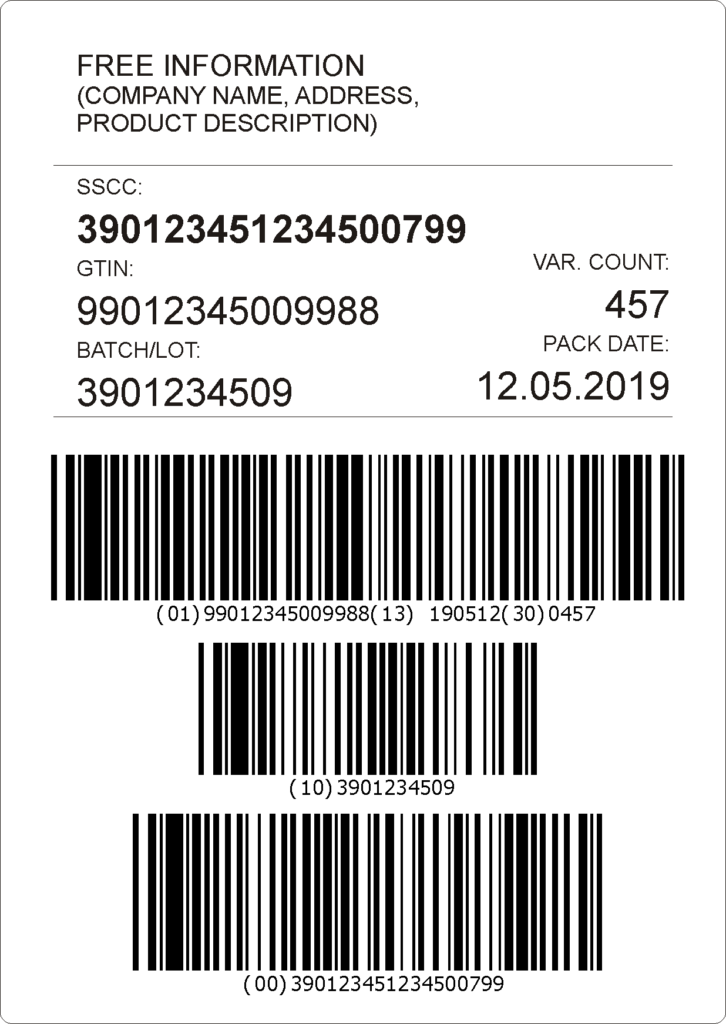
Logistics labels hides a lot of information. It is encoded in the form of the GS1-128 barcode. This is the most recognizable GS1 element used on the logistics label to encode logistics units. Moreover, 11 global identifiers have been created, which are used by all users of the GS1 system. The most important of these are:
| Identifier | Full name | Role in the logistics label |
|---|---|---|
| SSCC | Serial Shipping Container Code | An 18-character number used to identify logistics units. |
| GTIN | Global Trade Item Number | A unique product identifier that is the basis for barcodes used in the GS1 system. |
| GLN | Global Location Number | Allows identification of companies, warehouses or points of sale; added optionally. |
How to create an SSCC code?
Creating a GS1 logistics label is an important task that should be handled by the manufacturer or distributor of a given product. First, the company must register with the GS1 organisation and obtain a GS1 Company Prefix, which will be the unique identifier of your company. This prefix forms the beginning of each SSCC code. The number consists of 18 digits and has a defined structure.
Who assigns the SSCC number?
To receive a specific GS1 prefix with numbers for identifying products, locations and logistics units, you need to sign an agreement with the GS1 organisation. Count your products, read the terms and conditions, and order the code by completing the online application form.
In other words, to generate an SSCC code, a company must register with the GS1 organisation and receive its own prefix. This prefix forms part of the SSCC code. As a result, each assigned number is unique and can be tracked throughout the entire supply chain.
What is the GS1 system? What role does it play for logistics labels?
The GS1 system is a global set of standards for identifying products, services, locations and logistics units, used in many industries around the world. It allows the unification of labels in the supply chain, which significantly facilitates logistics management, trade, as well as communication between companies.
The international organization GS1, which is behind the whole idea, manages the developed system, and its main goal is to facilitate the exchange of information on a global scale through uniform identification standards, such as barcodes and QR codes. The GS1 rules are consistent and identical in all countries that have implemented them.
Thanks to it, people working in the manufacturing industry, as well as retailers, wholesalers or operators, can easily and clearly communicate information about the goods being transported. Properly generated labels make it possible not only to identify the product, but also to track it. Other functions of the GS1 system are:
- data standardization – bar codes, labels and identification systems enable companies around the world to exchange information seamlessly,
- automation – GS1 significantly supports the automation of business processes through the use of barcode scanning technology, RFID and other modern tools. Automation speeds up warehouse receipt, inventory or shipping, while minimizing errors due to manual data entry,
- streamlining communication between companies around the world,
- increase transparency – by being able to track units from production to delivery to the customer,
- support sustainability – by optimizing processes, better managing inventory, and reducing product and resource waste, companies can reduce their carbon footprint.
Use Etisoft’s support. With us, you can purchase everything you need for independent label design and printing: at Etisoft you will buy everything from one hand: labels and markings, thermal transfer ribbons, Auto ID devices (printers, barcode readers, ETILABEL software.
Let’s talk about your process and see how you can prepare GS1 labels faster, correctly and conveniently — within one coherent solution.
Do you need support? Get in touch with us!
FAQ
What is a GS1 logistics label?
A GS1 logistics label is a standardized shipping label that contains essential tracking and identification data, including the SSCC number, to facilitate efficient supply chain management and ensure accurate delivery.
How do I create a GS1 SSCC number?
To generate an SSCC number, you need a GS1 Company Prefix, which uniquely identifies your company, and proper software that complies with GS1 standards to encode the number correctly on your labels.
What information must be included on a GS1 logistics label?
A GS1 logistics label must include the SSCC (Serial Shipping Container Code), recipient details, shipment data, and any other required identifiers encoded according to GS1 standards for seamless tracking.
Can I design and print my own GS1 logistics labels?
Yes, if your company has a GS1 Company Prefix and uses compliant software like ETILABEL, you can independently design and print your GS1 logistics labels to meet industry standards.
What software tools are recommended for designing GS1 compliant labels?
ETILABEL software is recommended for designing and printing GS1 logistics labels independently, as it ensures compliance with GS1 standards and simplifies the label creation process.