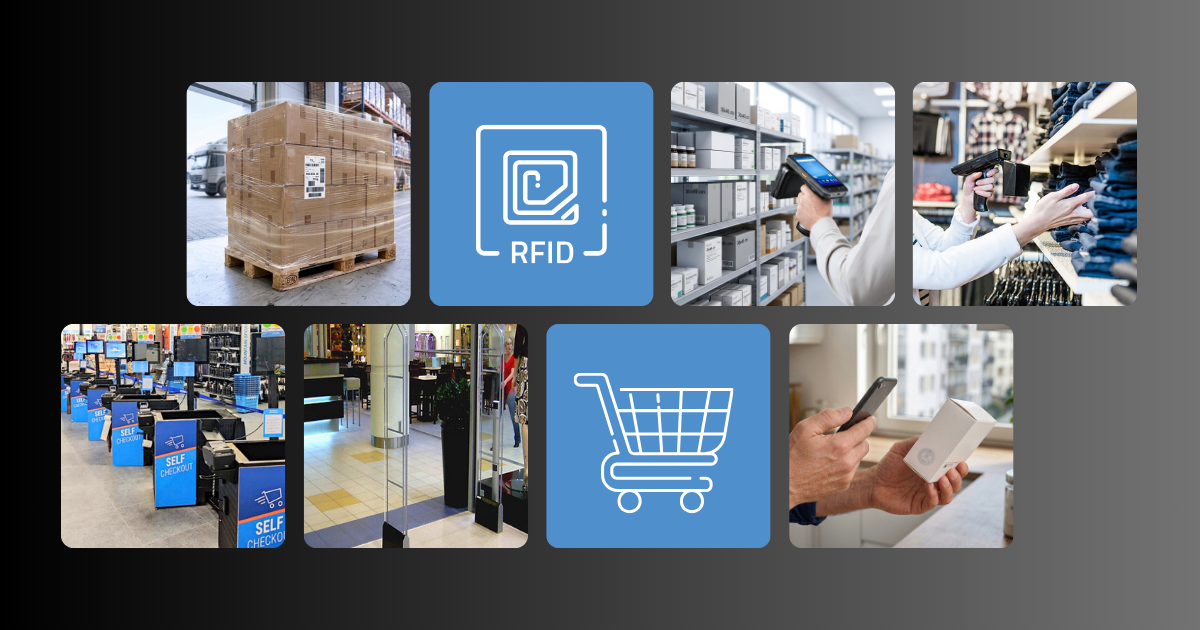
RFID in retail: Why retail chain suppliers must be ready for RFID labels
More and more large retail chains are deploying RFID technology as an operational standard. Some do it at the final product level, while others are focusing on the pallet level for now. Examples of such initiatives include Decathlon, Walmart, and apparel groups like LPP. For the suppliers of these chains, this means only one thing: the RFID label is becoming a core logistical requirement, without which cooperation may prove impossible. Today, RFID in retail is no longer just a technology that supports sales and logistics; it is increasingly a prerequisite for smooth cooperation with major buyers.
Table of Contents
What do chains use RFID in retail for?

Retail chains implement RFID to streamline product identification, inventory management, logistics, and sales processes. Utilizing RFID in retail allows for faster management of goods at various stages of the supply chain.
| Area of RFID in retail utilization | Application of RFID technology |
| Product identification | Automatic identification of individual products. |
| Inventory management | Fast and highly accurate stocktaking in stores. |
| Supply chain | Tracking goods from the manufacturer, through distribution centers, all the way to the store shelf. |
| Checkout processes and shrink | Streamlining checkout operations and reducing stock loss. |
Consequently, RFID labels are appearing on individual products as well as logistical units like cartons and pallets. Therefore, RFID labels in the retail industry support not only store operations but also the backend processes managed by manufacturers and suppliers.
RFID labels for retail chains must strictly comply with specifications
RFID is not about using “just any label” – compliance with specifications is what truly matters. While each retail chain defines its own RFID specification, in practice, they all rely on the exact same international standards.
RFID label encoding in compliance with EPC / GS1
The data stored on the tag must comply with GS1/EPCglobal standards. The most frequently used format is SGTIN-96, which contains the product’s GTIN number along with a unique serial number for every single item. For shipping units, SSCC-96 or increasingly SSCC+ formats are used.
Error-free GS1 labels: ETILABEL with GS1 compliance certification
UHF RFID EPC Gen2 / ISO 18000-6C
EPC Gen2 / ISO 18000-6C is the UHF RFID communication standard that guarantees label compatibility with retail chain infrastructure. Thanks to this, RFID in retail tags can interface seamlessly with the systems used by the buyers.
| Standard | Meaning for the supplier |
| EPC / GS1 | Data within the tag must strictly comply with GS1/EPCglobal standards. |
| SGTIN-96 | A format containing the product’s GTIN and a unique item serial number. |
| SSCC-96 / SSCC+ | Identification marking for shipping units. |
| EPC Gen2 / ISO 18000-6C | The UHF RFID communication standard ensuring full compatibility with the network’s infrastructure. |
Failing to comply with these requirements can lead to severe risks:
| Risk | Possible consequence |
| Non-compliance with RFID specifications | Delays in goods receiving at the warehouse. |
| Incorrect data on the tag | Additional operational costs passed down to the supplier. |
| Labeling or encoding errors | In extreme cases, complete rejection of the entire delivery. |
Because of this, RFID labels for retail chain suppliers must not only be perfectly selected for the specific product but also correctly encoded according to the recipient’s exact guidelines.
Design and print logistics labels in accordance with the GS1 standard!
Ask for an offer!Types of RFID labels in retail tailored to different product types
Different product categories require different forms of RFID tags. ETISOFT manufactures various RFID labels used across a wide range of product types.
Product RFID labels and RFID tags for packaging
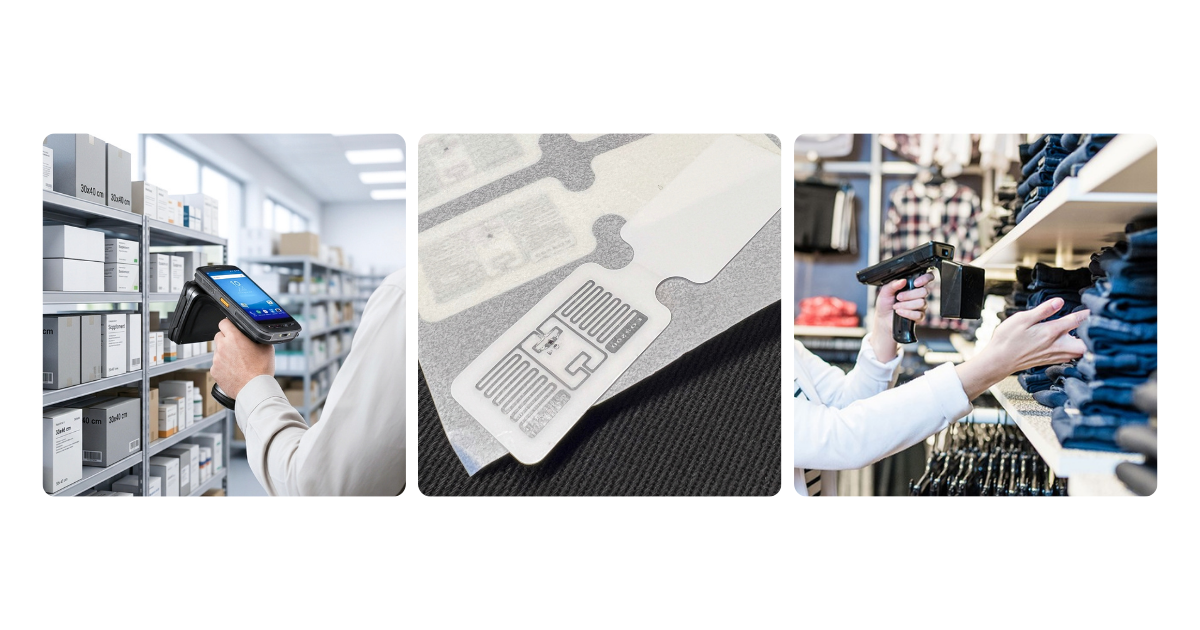
| Type of RFID label | Application |
| Classic product RFID labels | For standard product packaging. |
| Flag-type RFID labels | For oval or curved items. |
| RFID cardboard tags (hangtags) | For apparel, textiles, and other products where sticking a label directly is impossible. |
| RFID labels for metal cans and liquid bottles | For products requiring specialized label matching to avoid interference. |
| RFID care labels / inlays | For clothing and textiles. |
Logistics RFID labels for cartons and pallets
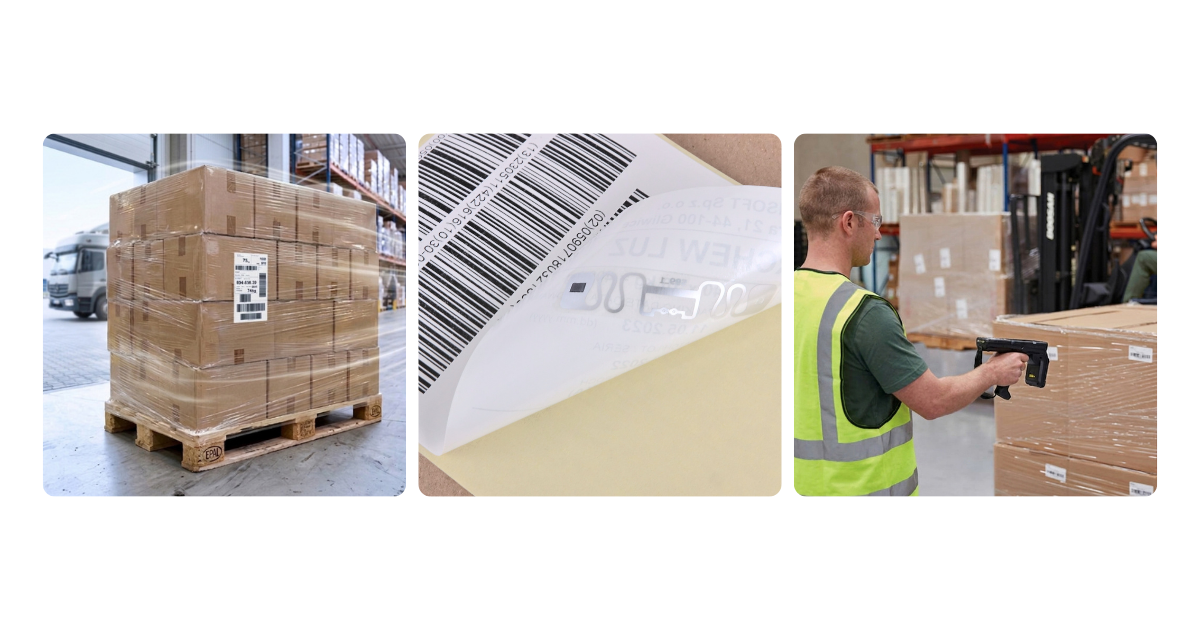
| Type of marking | Application in logistics |
| Logistics RFID labels for cartons | For marking master cartons and bulk packaging. |
| RFID labels for pallets | For marking logistical and shipping units. |
Every variant meets these key requirements:
| Requirement | What it means in practice |
| Operational standard | Runs on the UHF EPC Gen2 (ISO 18000-6C) standard. |
| Encoding | Can be encoded in compliance with GS1, e.g., SGTIN-96. |
| Buyer compliance | Will meet the specific requirements of targeted retail chains. |
RFID for retail chain suppliers – benefits beyond logistics
Although an RFID label carries a higher initial cost than a standard label, its implementation can bring tangible operational and financial rewards to any manufacturing company.
Marking pallets with an RFID label is particularly crucial in logistics, as it enables rapid, automated goods receiving and minimizes operational errors. Implementing RFID in retail supply chains supports the automatic identification of products and logistical units from the manufacturer right up to the store floor.
Product RFID labeling and process automation
Marking products and logistical units with RFID enables:
| Benefit of implementing RFID | Meaning for the supplier |
| Automated warehouse inventory | Drastically faster and more accurate than using standard barcodes. |
| Better stock control | Reduction of stockouts and much higher inventory transparency. |
| Faster order picking and shipping | Streamlining of core warehouse and logistics processes. |
| Reduction of logistics errors | Fewer mistakes made during shipping and dispatch. |
| Full product traceability | End-to-end traceability right down to a single unique item. |
| System integration | The ability to integrate RFID data directly into your own WMS/ERP systems. |
In practice, this means that RFID can be leveraged not just to satisfy the demands of retail networks, but also as a powerful tool to optimize your own internal operations. Therefore, deploying RFID in retail simultaneously addresses buyer mandates while fueling the growth of the supplier’s internal logistics.
Why choose Etisoft for implementing RFID in retail?
ETISOFT provides end-to-end support for suppliers, delivering the exact solutions needed to prepare products and logistical units according to strict retail chain requirements.
Comprehensive Etisoft solutions for RFID in retail
| Area of support | Etisoft solutions |
| Labels | RFID labels fully compliant with retail chain requirements. |
| Encoding | Correct EPC encoding and SGTIN-96 serialization upon request. |
| Tag quality | Proven quality and excellent readability of all tags. |
| Printing | Thermal transfer printers equipped with RFID encoding options. |
| Application automation | Automatic applicators with print-and-encode RFID label functionality. |
| RFID reading | High-performance RFID readers and antennas. |
| Mobile data handling | Mobile RFID data terminals. |
| Software | Dedicated software for RFID readers and terminals. |
| Training | Specialized training on correct printing and encoding of RFID labels according to buyer specifications. |
This allows manufacturers and suppliers to implement RFID comprehensively, true to the Etisoft vision of “From labels to Industry 4.0,” while remaining fully confident that they meet all retail chain mandates.
Ultimately, RFID in retail is shifting from being just a big-box chain requirement to a cornerstone of modern, automated logistics. Correctly selected RFID labels, accurate encoding, and strict compliance with buyer specifications empower suppliers to secure their partnerships with retail networks while optimizing their own operational workflows.
Match your RFID labels to your retail chain’s requirements!
FAQ
Is an RFID label mandatory for retail chain suppliers?
An RFID label is not mandatory for all suppliers across the board, but an increasing number of major retail chains are making it a core part of their logistical requirements. In practice, this means that if you supply a specific network, you may be required to mark your items, cartons, or pallets with RFID labels that match the buyer’s exact specifications. Lacking such marking can result in delivery intake delays, chargebacks, or complete rejection of the shipment.
How do I choose the right RFID label for my product type and packaging?
An RFID label must be selected based on the product type, packaging material, surface shape, and scanning environment. A standard cardboard box requires a completely different solution than an oval object, a metal can, a bottle containing liquid, or a garment. Depending on the application, you can use classic product RFID labels, flag-type RFID labels, hangtags, RFID care labels, or logistics RFID labels for cartons and pallets. It is equally critical that the label operates on the UHF EPC Gen2 / ISO 18000-6C standard and can be encoded according to GS1 guidelines.
What benefits does RFID offer a supplier within the warehouse and logistics?
RFID offers great advantages not just for satisfying retail chains, but within your own warehouse and logistics setup. Tagging products and logistical units allows for automated inventory counts, tighter inventory control, faster order picking/shipping, and a sharp drop in shipping errors. RFID also supports total item-level traceability. Furthermore, the technology can be tied directly into your WMS and ERP software to automate everyday operations.
What are the main applications of RFID labels in retail?
In the retail sector, RFID labels are primarily used for automatic product identification, rapid stocktaking, real-time inventory control, and supply chain tracking. Retail networks utilize RFID on individual items as well as cartons and pallets to speed up receiving, streamline order picking, accelerate checkout lanes, and reduce inventory shrink. Thanks to these labels, flawless product traceability is achieved all the way from the manufacturer, through the distribution hub, straight to the shop shelf.
Which companies offer RFID solutions in Poland?
In Poland, RFID solutions are provided by a mix of RFID tag/label manufacturers, system integrators, and hardware vendors supplying printers, readers, antennas, and software. When choosing a partner to implement RFID in retail, it is vital to look beyond product availability and focus on deep experience in labeling, encoding, and logistics automation. Etisoft stands out with highly specialized competencies here because we combine top-tier RFID label manufacturing with complete hardware delivery and deployment support. The company offers retail-compliant RFID labels, accurate EPC encoding, SGTIN-96 serialization, thermal transfer printers with RFID capabilities, label applicators, readers, antennas, data terminals, and custom software. This ensures a supplier can roll out RFID end-to-end—from choosing the right label and printing/encoding it, to automated data capture in the warehouse. Etisoft’s expertise is incredibly valuable for companies working with retail networks, where RFID in retail demands strict adherence to buyer specifications, GS1/EPC standards, and exact label matching to products, packaging, cartons, or pallets. In practice, Etisoft does not just ship labels; we support the entire process of getting a supplier fully ready to meet retail chain demands.
